SW1911PD Range Report
A new lightweight 1911 was inevitable when Smith & Wesson began making their version of "old slabsides". In 2004, S&W first introduced the scandium alloy framed SW1911Sc. It weighed an overall 28-ounces, as opposed to the near 40-ounce weight of a standard Government Model. The pistol was an instant hit for a carry gun, and has proven to be durable and reliable. In 2006, Smith & Wesson showed they listened well to their customer base when they released the SW1911PD. The SW1911PD was essentially the same pistol, blacked out, with more discreet markings on the slide. 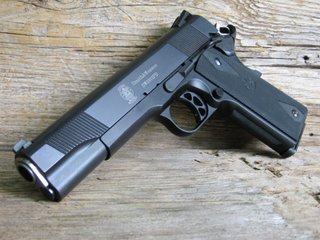 When I found a used SW1911PD for sale at a good price, I quickly snapped it up.
Like the SW1911s before it, The SW1911PD has a serrated frontstrap, Novak sights, and a grip safety activated firing pin safety. The small parts are made of MIM, and the mainspring housing is checkered aluminum. From the factory, the pistol has a solid full length guide rod, and forward slide serrations, both of which I can live without. The external extractor on the SW1911 is not what John Moses Browning designed, (or rather, what the US Army requested), but Smith & Wesson had a lot of experience with external extractors on their double action auto loaders. Where external extractors fail on other 1911s, the S&W unit has a reputation for keeping on ticking.
To bring the pistol closer to my idea of a carry gun, I installed rubber S&W grips, a GI recoil set-up, and did a trigger job on it. Astute readers may notice a marking gone. With a Wilson magazine stuffed inside, I was ready to take the pistol to the range for reliability testing.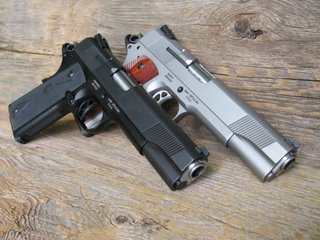 I brought along 250 rounds of Winchester White Box 230 grain target ammo, as well as 50 rounds of Federal 230 grain HydraShoks. I also took a standard SW1911 to compare the scandium framed pistol to.
I had read how the scandium 1911s were more difficult to shoot, due to their lighter weight. I prepared myself for that, but I refuse to wear shooting gloves. Over the past three years, I had not read a single complaint regarding the frame being weak. That is a good thing, because I like to train with what I carry. If a pistol cannot stand up to the pounding I will give it in training, I really don't want to stake my life on it.
I started shooting with the SW1911PD, first, just making certain it was safe after my gunsmithing efforts, and then trying to make it jam. I limp wristed it. I shot it sideways. I rode my thumb on the slide. I shot it upside down. Not once did it fail to feed and shoot. The safeties functioned positively as advertised.
I shot all 300 rounds through the SW1911PD. It was a blast to shoot. It had a quick, certain return to sights, allowing for rapid recovery and follow-up shots. I found absolutely no difference in muzzle flip than what I am used to in a Government Model. Perhaps this is because I use a very strong isometric grip in a Chapman stance for my shooting. With my grip, the weight of the frame is simply not a factor in recoil.
I was, frankly, having a blast. Two shooters with Glocks were off to my right, and I was eating them up at 30 feet. I was punching holes in an index card taped to the chest of a silhouette target. There was a single ragged hole in that card. I was flying high. The SW1911PD was accurate. If I slowed down, it was a precision shooter. Then, I had a problem........I was out of ammo.
Damn. I went to the counter, and I bought another 100 rounds of 230 grain MagTech ammo. I decided I had better switch to the standard framed SW1911 immediately. I noted that the perceived recoil and muzzle flip was the same in my hands.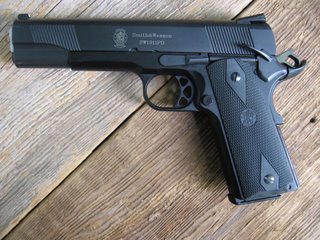 I shot about 25 rounds through the standard SW1911 and I realized something else. The SW1911PD was actually easier for me to shoot! I could hold it up, with less effort, for a longer period of time. No wonder I had unknowingly blazed through my ammunition. My arms simply were not getting tired from holding the extra weight extended at arms length!
I only have 375 rounds through this pistol thus far, but it is showing great potential as a carry gun. I have little doubt that the reduced weight on my belt will result in less fatigue at the end of the day. I would have absolutely no hesitation about recommending this pistol to a woman as a carry gun, assuming she is familiar with the 1911 platform, and uses an isometric grip. I look forward to passing the 1000 round mark and putting the pistol into service as a carry piece.
Then, I wondered how it would compare to my Colt Compact.
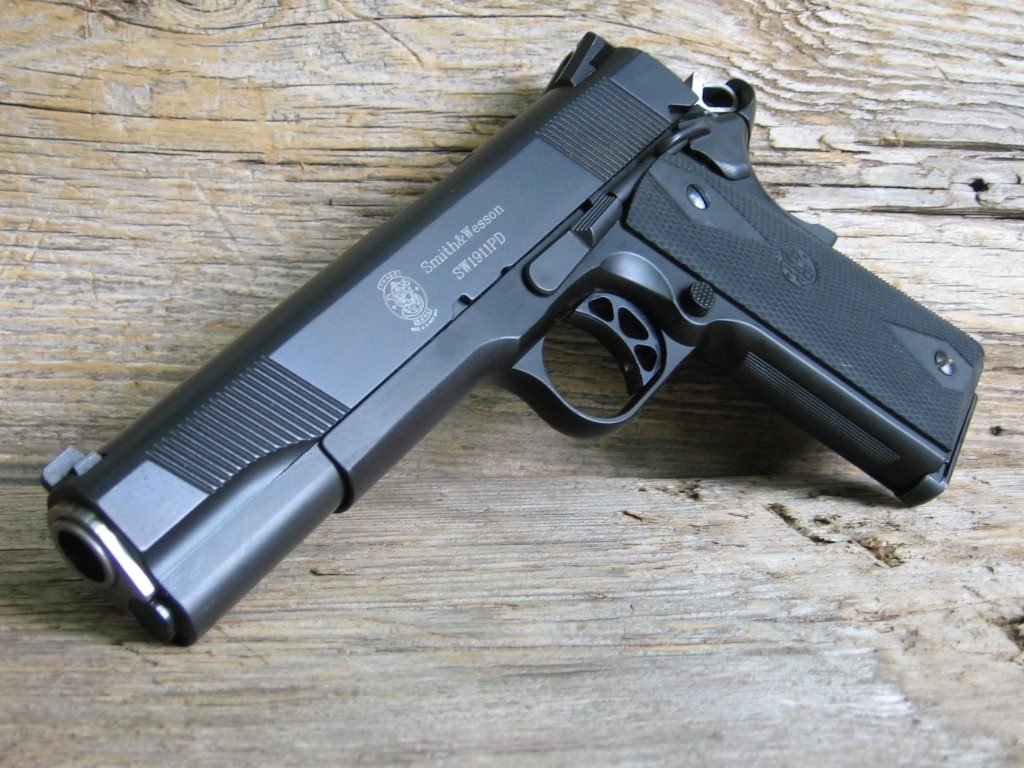 When I found a used SW1911PD for sale at a good price, I quickly snapped it up.
 Like the SW1911s before it, The SW1911PD has a serrated frontstrap, Novak sights, and a grip safety activated firing pin safety. The small parts are made of MIM, and the mainspring housing is checkered aluminum. From the factory, the pistol has a solid full length guide rod, and forward slide serrations, both of which I can live without. The external extractor on the SW1911 is not what John Moses Browning designed, (or rather, what the US Army requested), but Smith & Wesson had a lot of experience with external extractors on their double action auto loaders. Where external extractors fail on other 1911s, the S&W unit has a reputation for keeping on ticking.
To bring the pistol closer to my idea of a carry gun, I installed rubber S&W grips, a GI recoil set-up, and did a trigger job on it. Astute readers may notice a marking gone. With a Wilson magazine stuffed inside, I was ready to take the pistol to the range for reliability testing.
 I brought along 250 rounds of Winchester White Box 230 grain target ammo, as well as 50 rounds of Federal 230 grain HydraShoks. I also took a standard SW1911 to compare the scandium framed pistol to.
I had read how the scandium 1911s were more difficult to shoot, due to their lighter weight. I prepared myself for that, but I refuse to wear shooting gloves. Over the past three years, I had not read a single complaint regarding the frame being weak. That is a good thing, because I like to train with what I carry. If a pistol cannot stand up to the pounding I will give it in training, I really don't want to stake my life on it.
I started shooting with the SW1911PD, first, just making certain it was safe after my gunsmithing efforts, and then trying to make it jam. I limp wristed it. I shot it sideways. I rode my thumb on the slide. I shot it upside down. Not once did it fail to feed and shoot. The safeties functioned positively as advertised.
I shot all 300 rounds through the SW1911PD. It was a blast to shoot. It had a quick, certain return to sights, allowing for rapid recovery and follow-up shots.
 I found absolutely no difference in muzzle flip than what I am used to in a Government Model. Perhaps this is because I use a very strong isometric grip in a Chapman stance for my shooting. With my grip, the weight of the frame is simply not a factor in recoil.
 I was, frankly, having a blast. Two shooters with Glocks were off to my right, and I was eating them up at 30 feet. I was punching holes in an index card taped to the chest of a silhouette target. There was a single ragged hole in that card. I was flying high. The SW1911PD was accurate. If I slowed down, it was a precision shooter. Then, I had a problem........I was out of ammo.
Damn. I went to the counter, and I bought another 100 rounds of 230 grain MagTech ammo. I decided I had better switch to the standard framed SW1911 immediately. I noted that the perceived recoil and muzzle flip was the same in my hands.
 I shot about 25 rounds through the standard SW1911 and I realized something else. The SW1911PD was actually easier for me to shoot! I could hold it up, with less effort, for a longer period of time. No wonder I had unknowingly blazed through my ammunition. My arms simply were not getting tired from holding the extra weight extended at arms length!
 I only have 375 rounds through this pistol thus far, but it is showing great potential as a carry gun. I have little doubt that the reduced weight on my belt will result in less fatigue at the end of the day. I would have absolutely no hesitation about recommending this pistol to a woman as a carry gun, assuming she is familiar with the 1911 platform, and uses an isometric grip. I look forward to passing the 1000 round mark and putting the pistol into service as a carry piece.
Then, I wondered how it would compare to my Colt Compact.
posted by Xavier at 4:41 PM
0 comments