Clark Combat Colt 1911
Long before Bill Wilson ever checkered a front strap, James E. Clark had found a way to glue a pistol into a competitor's sweaty hand. Jim Clark had been customizing pistols for eighteen years when Ed Brown decided to become a part time gunsmith. 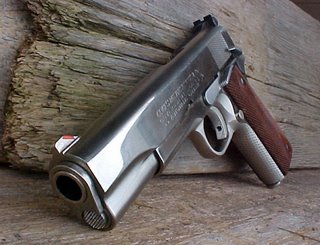 Jim Clark was a founding member and the first President of the American Pistolsmiths Guild. As a competitor, perhaps he was proudest of being the only civilian trained national bullseye champion. In 1950, Jim Clark founded Clark Custom, and began a career of producing no bull shit competitive pistols based on the 1911. One must remember that surplus GI pistols were the raw materials of building a race gun then. There were few parts on the market to augment a gunsmith's ability. If a man could not weld, fabricate and create, he could forget being a gunsmith. In this environment, Jim Clark Sr. flourished, laying the groundwork and ideas for the many permutations of the 1911 pistol that were to follow. His son, Jim Clark Jr. continues his father's legacy at Clark Custom, but as a North Louisiana resident, I always hoped to find a gun made by Jim Clark the Elder. Even in the piney woods of North Louisiana they are precious heirlooms, as rare as turtle teeth, or priced like golden boudin when they appear.
Finally, after years of perseverance, fortune would shine on me, and I found a Jim Clark the Elder gun that I could afford.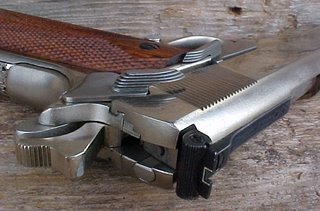 This pistol was ordered from Jim Clark by an anesthesiologist in 1981. It is built on a Colt Mark IV Series 70 base gun. He shot a "box or two" of ammunition through it and put it away. Eventhough this pistol does have a King's extended safety and slide stop, they were impeccably fitted by the old man himself. The lockwork on this pistol snicks back and forth with a precision and an ease that belies it's close tolerances.
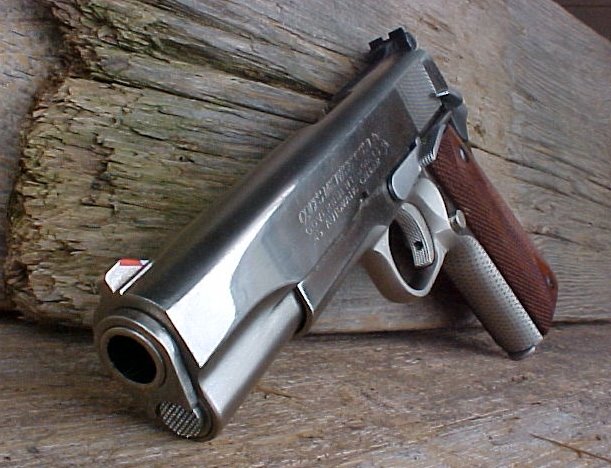
In this gun Jim Clark was not attempting to build a beautiful gun. It is almost ironic that he inadvertently did.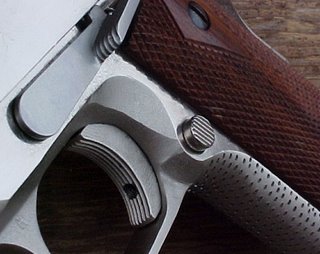 Nickel was laid across this pistol not to provide additional glitz, but to effectively prevent rust in the sweltering Louisiana heat. When Jim Clark needed a competition trigger, he simply took the original Colt trigger, drilled and tapped it for a set screw, and then adjusted the length of the stirrup by welding a polished shim at the back to achieve a zero take up, minimal over travel trigger. The pull was adjusted through polishing the trigger stirrup, adjusting the sear angle, hammer hooks and sear spring. This pistol has a trigger that breaks consistently at three pounds with no wiggling around in the trigger guard.
To cement the gun in the shooter's hand, Clark applied his trademark stippling to the front strap and mainspring housing. Clark's technique is not as pretty as Ted Yost's perfect checkering, nor as fashionable as Ed Brown's reptilian scales. Clark's stippling is incredibly effective however. Grasping it is like holding a rasp in your fist. When the little metal teeth created by Clark's chisel bite into one's calloused hand, this pistol is not going to shift under recoil.
In 1981, Clark offered low mounted Bomar adjustable sights, or Smith & Wesson K frame adjustable sights.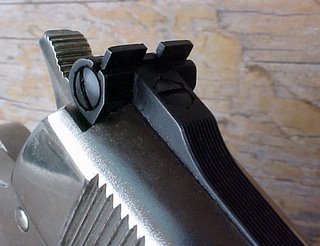 Like many early shooters, my anesthesiologist friend opted for the S&W sights. They were a known quantity with an available parts supply, and when mounted correctly, they compliment the lines of the 1911. Indeed, they almost look like the Gold Cup's Eliason sight. It is indicative of Jim Clark's craftsmanship that not a hint of the original rear sight dovetail remains to be seen through the nickel finish. Unless the hammer was placed beside an original, the bobbed hammer is just as stealthy. Clark paired the Smith & Wesson rear sight with a ramped hardball front sight, into which he grafted an orange plastic insert. The orange portion of the front sight precisely fills the rear notch. There is no more nor less than necessary.
Today, when Clark 1911s are mentioned, many people visualize the incomparable Clark Meltdown.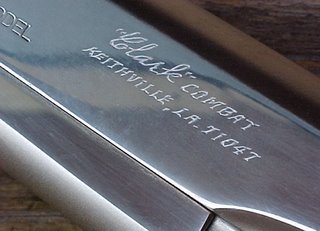 Clark Custom is not founded on the Meltdown, but rather on guns that work. Jim Clark was not known for building beautiful guns. Indeed, Armand Swenson was the man to go to for a beautiful custom Colt in those days. Jim Clark was known for building effective guns. When I purchased this pistol, the seller also supplied me with the original paperwork. This pistol received Clark's "Combat Conversion", consisting of an accuracy job, trigger job, the S&W rear sight, front strap stippling, ramp work, lowered ejection port, and mag well bevel. The seller had also requested the extended safety and slide release, stippled mainspring housing, orange sight insert, and white outlined rear sight. The 1981 base price for the pistol was $352. The Combat Conversion and extras cost $393.50, for a total of $745.50 in 1981 money.
Even today, Clark guns are commonly the homeliest gun on the line at any competition. Their effectiveness, however depends solely on the shooter.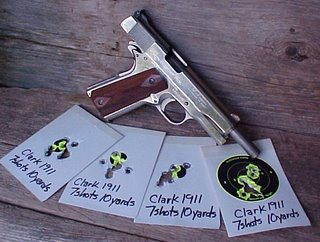 They make no excuses. Jim Clark guaranteed a three inch ten shot group at fifty yards. Today, other manufacturers, most notably Les Baer, make the same guarantee. They, however, manufacture their own frames and slides on CNC equipment. Jim Clark honored his guarantee on a Colt 1911 that he peened the rails on, and welded up and refitted the factory barrel on himself.
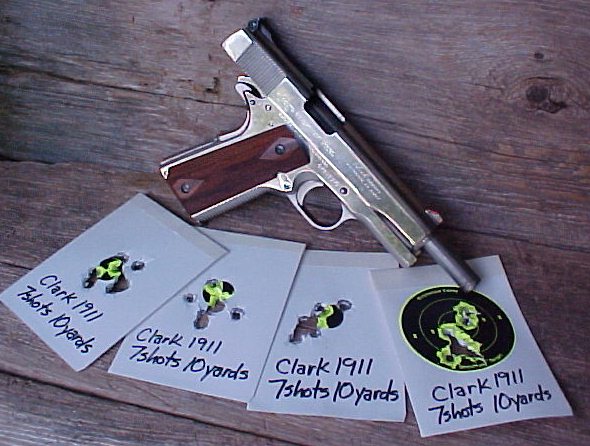
When I took this pistol to the range with a couple of boxes of 230 grain hard ball, Jim Clark's work spoke for itself. This pistol shot like a hellcat. It had no stoppages and tossed the empties neatly to my right. The pistol shot every bit as well as I was able. It came to sights quickly and accurately. It placed every shot exactly where I aimed it. In 1981, Jim Clark created a pistol that continues to impress twenty five years later. That is nothing short of amazing.
More
 Jim Clark was a founding member and the first President of the American Pistolsmiths Guild. As a competitor, perhaps he was proudest of being the only civilian trained national bullseye champion. In 1950, Jim Clark founded Clark Custom, and began a career of producing no bull shit competitive pistols based on the 1911. One must remember that surplus GI pistols were the raw materials of building a race gun then. There were few parts on the market to augment a gunsmith's ability. If a man could not weld, fabricate and create, he could forget being a gunsmith. In this environment, Jim Clark Sr. flourished, laying the groundwork and ideas for the many permutations of the 1911 pistol that were to follow. His son, Jim Clark Jr. continues his father's legacy at Clark Custom, but as a North Louisiana resident, I always hoped to find a gun made by Jim Clark the Elder. Even in the piney woods of North Louisiana they are precious heirlooms, as rare as turtle teeth, or priced like golden boudin when they appear.
 Finally, after years of perseverance, fortune would shine on me, and I found a Jim Clark the Elder gun that I could afford.
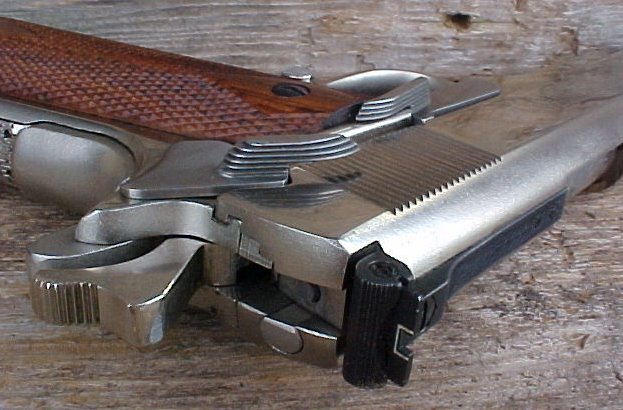 This pistol was ordered from Jim Clark by an anesthesiologist in 1981. It is built on a Colt Mark IV Series 70 base gun. He shot a "box or two" of ammunition through it and put it away. Eventhough this pistol does have a King's extended safety and slide stop, they were impeccably fitted by the old man himself. The lockwork on this pistol snicks back and forth with a precision and an ease that belies it's close tolerances.
 In this gun Jim Clark was not attempting to build a beautiful gun. It is almost ironic that he inadvertently did.
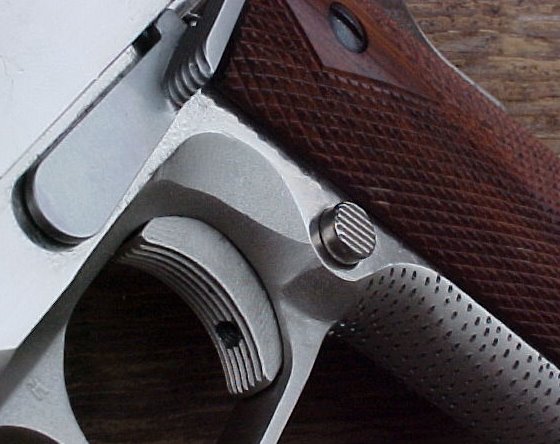 Nickel was laid across this pistol not to provide additional glitz, but to effectively prevent rust in the sweltering Louisiana heat. When Jim Clark needed a competition trigger, he simply took the original Colt trigger, drilled and tapped it for a set screw, and then adjusted the length of the stirrup by welding a polished shim at the back to achieve a zero take up, minimal over travel trigger. The pull was adjusted through polishing the trigger stirrup, adjusting the sear angle, hammer hooks and sear spring. This pistol has a trigger that breaks consistently at three pounds with no wiggling around in the trigger guard.
 To cement the gun in the shooter's hand, Clark applied his trademark stippling to the front strap and mainspring housing. Clark's technique is not as pretty as Ted Yost's perfect checkering, nor as fashionable as Ed Brown's reptilian scales. Clark's stippling is incredibly effective however. Grasping it is like holding a rasp in your fist. When the little metal teeth created by Clark's chisel bite into one's calloused hand, this pistol is not going to shift under recoil.
In 1981, Clark offered low mounted Bomar adjustable sights, or Smith & Wesson K frame adjustable sights.
 Like many early shooters, my anesthesiologist friend opted for the S&W sights. They were a known quantity with an available parts supply, and when mounted correctly, they compliment the lines of the 1911. Indeed, they almost look like the Gold Cup's Eliason sight. It is indicative of Jim Clark's craftsmanship that not a hint of the original rear sight dovetail remains to be seen through the nickel finish. Unless the hammer was placed beside an original, the bobbed hammer is just as stealthy. Clark paired the Smith & Wesson rear sight with a ramped hardball front sight, into which he grafted an orange plastic insert. The orange portion of the front sight precisely fills the rear notch. There is no more nor less than necessary.
 Today, when Clark 1911s are mentioned, many people visualize the incomparable Clark Meltdown.
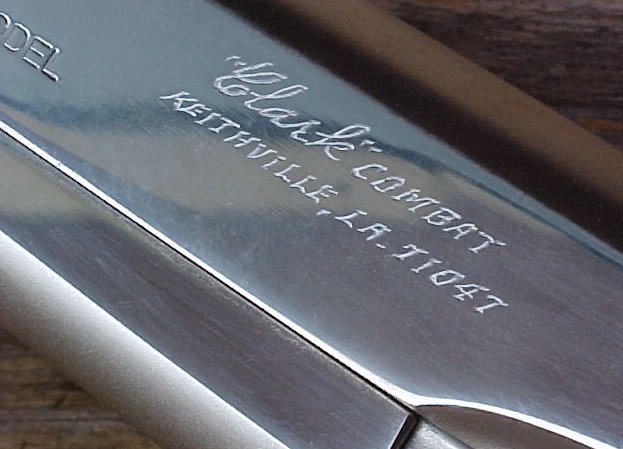 Clark Custom is not founded on the Meltdown, but rather on guns that work. Jim Clark was not known for building beautiful guns. Indeed, Armand Swenson was the man to go to for a beautiful custom Colt in those days. Jim Clark was known for building effective guns. When I purchased this pistol, the seller also supplied me with the original paperwork. This pistol received Clark's "Combat Conversion", consisting of an accuracy job, trigger job, the S&W rear sight, front strap stippling, ramp work, lowered ejection port, and mag well bevel. The seller had also requested the extended safety and slide release, stippled mainspring housing, orange sight insert, and white outlined rear sight. The 1981 base price for the pistol was $352. The Combat Conversion and extras cost $393.50, for a total of $745.50 in 1981 money.
Even today, Clark guns are commonly the homeliest gun on the line at any competition. Their effectiveness, however depends solely on the shooter.
 They make no excuses. Jim Clark guaranteed a three inch ten shot group at fifty yards. Today, other manufacturers, most notably Les Baer, make the same guarantee. They, however, manufacture their own frames and slides on CNC equipment. Jim Clark honored his guarantee on a Colt 1911 that he peened the rails on, and welded up and refitted the factory barrel on himself.
 When I took this pistol to the range with a couple of boxes of 230 grain hard ball, Jim Clark's work spoke for itself. This pistol shot like a hellcat. It had no stoppages and tossed the empties neatly to my right. The pistol shot every bit as well as I was able. It came to sights quickly and accurately. It placed every shot exactly where I aimed it. In 1981, Jim Clark created a pistol that continues to impress twenty five years later. That is nothing short of amazing.
More
posted by Xavier at 9:38 PM
0 comments